How to order food in Spain
Spanish eating is a system with rules, and none of them are on the menu. Meals happen at specific hours, the best value is a fixed-price lunch nobody translates, and the cheapest, best seat in the house is standing at a counter. Learn the system once and every day of the trip gets better.
This is mechanics, not recommendations. Where to eat is in the Atlas, under Things to Do.
The meal clock
The single most useful thing to know is when Spain eats. Everything else — what is open, when a kitchen is closed, why the restaurant is empty at seven — follows from it.
Desayuno
Coffee and a tostada, standing at a bar, in about eight minutes.
Tostada con tomate y aceite is the default in the south; con mantequilla y mermelada in the north. Churros are a weekend and winter thing rather than an everyday breakfast, and a bar that only sells churros is a churrería.
El almuerzo
The mid-morning sandwich. A bocadillo and a coffee or a small beer.
In Valencia, Murcia and parts of Andalusia 'el almuerzo' means this, not lunch. It is a real meal at a real hour and the reason dinner can be at ten.
La comida
The main meal of the day. Three courses, wine, and no hurry afterwards.
This is the meal to build a day around. It is also the best value food in the country, because it is the meal Spaniards themselves eat out.
La merienda
Coffee and a pastry, or an ice cream in summer.
Mostly a habit rather than a fixture. Kitchens are shut, so this is what is available between lunch and the evening.
Vermut y tapas
A vermouth or a beer and something small, before going out properly.
Sunday late morning is the classic vermut hour, with olives and crisps on the table. In tourist areas this slot has been turned into dinner, which is why those places are full at eight.
La cena
A lighter meal, often fish, eggs or a shared plate.
Nine is early, ten is normal in summer and in the south. Restaurants that serve dinner at seven are serving visitors, and the kitchen will be honest about it.
At the bar
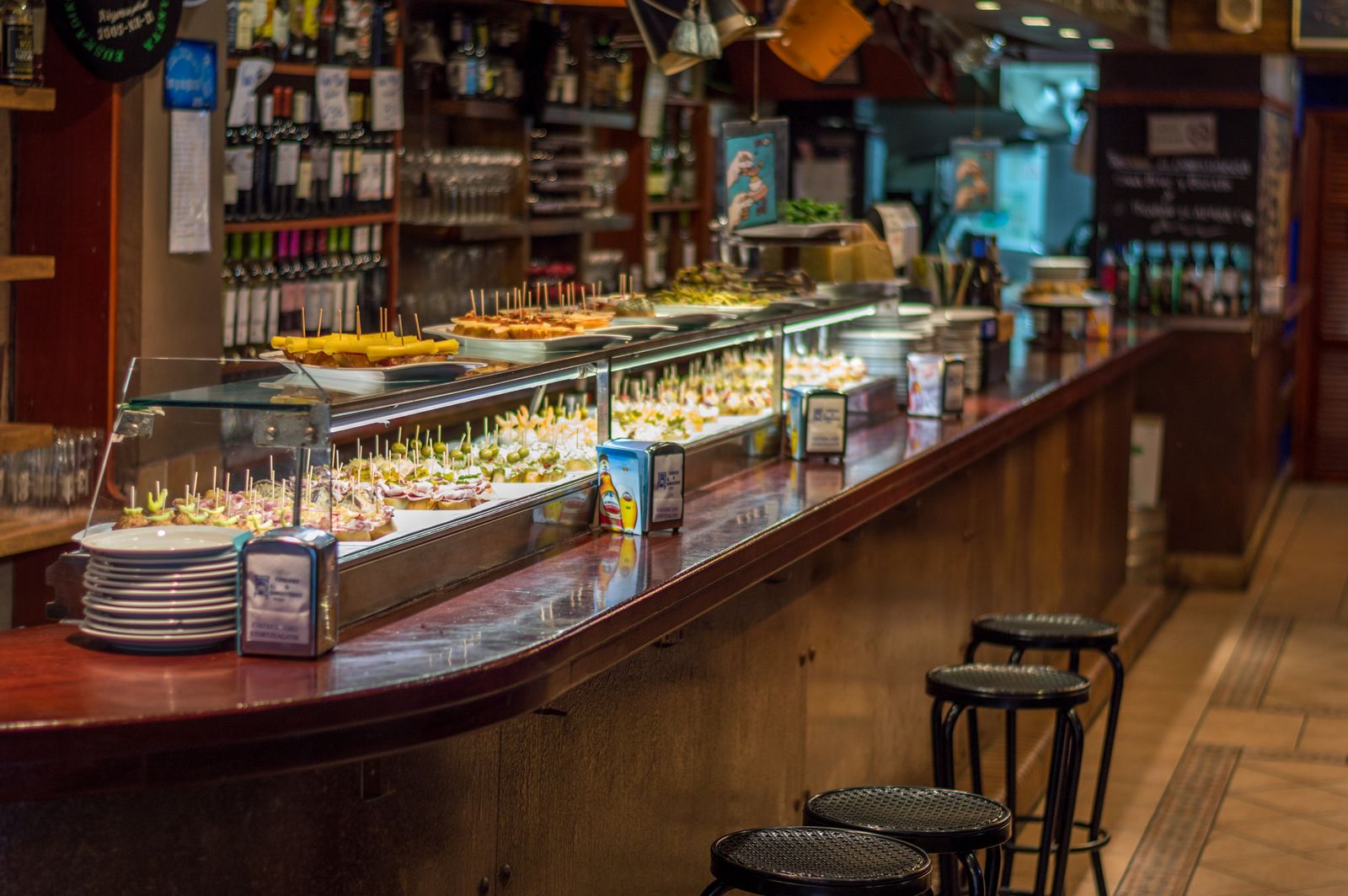
Spain eats standing up more than it eats seated. The bar counter is where the cheap price, the good food and the conversation are, and treating it as a waiting area is the most common visitor mistake.
- Tapa
- A small plate, one or two bites per person. In Granada, Almería and parts of León a tapa arrives with your drink whether you ordered one or not; in Madrid and the north it does not.
- Ración
- A full plate to share, roughly three or four times a tapa. Media ración is the middle size and usually the right order for two.
- Pincho / pintxo
- The Basque and Navarran version: something on a slice of bread, held together with a toothpick. In many bars you keep the picks and they count them at the end.
- Montadito
- A small sandwich. A bocadillo is the full-size version, and a bocata is the same thing said casually.
- Plato combinado
- Egg, chips, meat or fish, on one plate. Unfashionable, cheap, and exactly what you want at midnight.
- Sugerencias
- The off-menu list, often the best cooking in the house and rarely translated. Ask what is on it.
- —Order in rounds, not all at once. Two things, eat them, order two more. The food arrives as it is ready and stays hot.
- —Standing at the counter is usually cheaper than the terrace, and in some regions the difference is regulated rather than a tourist surcharge. It is also where you get served first.
- —The bill accumulates on a tab. Nobody brings it until you ask, and sitting on after you have finished is the point of the place.
- —Tap water is free and you can ask for it — 'agua del grifo, por favor'. Bottled is what arrives if you just say 'agua'.
- —Bread is often charged separately, and a 'cubierto' or terrace supplement appears on some bills. Both are legal and both should be on the menu.
- —If a plate of something you did not order appears, it is either the free tapa or a mistake. Ask before eating it; on a busy terrace it is sometimes the latter.
- —In a pintxo bar, take from the counter and keep your picks. In the best ones the hot pintxos are ordered from the kitchen and the cold ones are on the bar.
What to order, and what will arrive
Ordering 'un café' gets you an espresso. The rest of the list is how to get what you wanted.
- Café solo
- An espresso. If you order 'un café', this is what arrives.
- Cortado
- Espresso with a splash of milk. The default order of most of Spain after breakfast.
- Café con leche
- Half coffee, half milk, usually in a glass. Breakfast strength.
- Manchado
- Mostly milk with a dash of coffee. Common in Cantabria and the Levante; not universal.
- Bombón
- Espresso over condensed milk. Sweet, small, and better than it sounds.
- Carajillo
- Coffee with a shot of brandy or rum. A cold-morning, after-lunch order.
- Descafeinado de máquina
- Decaf from the machine. 'De sobre' means a sachet, served with hot milk on the side.
- Americano
- A long black. Ask for it by name; 'café' will not get you one.
- Café con hielo
- An espresso with a glass of ice, in summer. Order it and assemble it yourself.
What to say
Eleven phrases will get you through a week of eating well. The fuller language page, including pronunciation, is Useful Spanish.
Three sentences that change the meal
Three questions do more work than a phrasebook. None of them is about you, and all of them get you a better plate than the menu would have. Say them slowly, and let the answer run.
The single most useful sentence in Spain. It moves you off the printed page and onto whatever came in this morning or came out of the pot an hour ago. You will often be told in detail, with a gesture at someone else's table.
Gets you the method — plancha, brasa, guiso, fryer — which is what actually decides whether a dish is good here. It also settles portion size, because the answer usually includes a hand.
Never 'what wine do you recommend' — that is a sales question and gets a sales answer. This one asks what the room is drinking, and the answer is usually local, cheap and right.
What the waiter will ask you
The conversation follows the same six moves everywhere in the country. Knowing what is being asked is most of the work; the answers are four words each.
Drinks first, always. Food is ordered after the drinks arrive, so ordering both at once reads as a hurry. A caña, a vermut, water, or 'una botella de la casa'.
Something to share while you decide. It is not an upsell; it is the rhythm of the meal. Say yes if you are hungry, 'nada, gracias' if you are waiting for a proper lunch.
How would you like it cooked. 'Al punto' is medium, 'poco hecho' rare, 'muy hecho' well done. For fish it usually means plancha or fried, and the answer is 'a la plancha'.
The side, in a menú del día. Both are ordinary; the salad is often the better plate in a heavy kitchen.
The menú includes one or the other, not both. 'Café' is an espresso; 'cortado' if you want milk in it.
We are about to bring the bill. Either order the last thing or say 'la cuenta, cuando pueda' — nobody is waiting to rush you out.
What the words mean, region by region
Spanish food is not one cuisine, and the words change with the landscape. These are the dishes and terms you will meet on the ground in each region — the ones a translated menu usually gets wrong or leaves out.
Basque Country
The most serious eating in Spain, and the least translated.- Txuleta
- A thick, aged rib steak, grilled hard and served rare. Ordered by weight, for two.
- Marmitako
- Tuna, potato and pepper stew. A fisherman's dish, best in autumn.
- Kokotxas
- Cod cheeks, in pil-pil or grilled. The connoisseur's order and priced like it.
- Txakoli
- A sharp, slightly sparkling white poured from a height to knock the fizz out. Getxo, Zarautz, and every pintxo bar.
- Gilda
- An olive, an anchovy and a pickled guindilla on a stick. The cheapest good thing in San Sebastián.
Catalonia
Sweet-savoury cooking, and a menu in Catalan that is not a translation of the Spanish one.- Pa amb tomàquet
- Bread rubbed with tomato, oil and salt. Served with everything, charged sometimes.
- Calçots
- Grilled spring onions, dipped in romesco, eaten with a bib. January to April, at a masia, never in a city restaurant.
- Suquet
- A fish and potato stew with a picada of nuts and bread. Coastal, and usually excellent.
- Botifarra amb mongetes
- Grilled sausage with white beans. The everyday plate of the region.
- Crema catalana
- The local answer to crème brûlée: lemon and cinnamon, burnt sugar on top.
Galicia
Seafood priced as if the sea were not scarce, because here it is not.- Pulpo á feira
- Octopus, boiled, cut with scissors, paprika and oil. The region's signature plate.
- Empanada
- A flat tray-baked bread pie, cut in squares, not the pasty the word suggests elsewhere.
- Percebes
- Goose barnacles, harvested off rocks at risk. Boiled, eaten with your fingers, priced by the hundred grams.
- Pimientos de Padrón
- Blistered green peppers, salted. One in ten is hot, and no one knows which.
- Albariño
- The white of the Rías Baixas. Drink it with everything here and it will hold up.
Andalusia
Frying as a craft, cold soups as a religion, and the free tapa as a business model.- Pescaíto frito
- Mixed fried fish, in a light flour or batter. Best at a freiduría, eaten from paper.
- Salmorejo
- Thick cold tomato and bread soup with jamón and egg. Córdoba's, and not gazpacho.
- Rabo de toro
- Oxtail stew, slow and dark. Córdoba and Seville, in winter.
- Tortillitas de camarones
- Tiny shrimp fritters, Cádiz. Crisp, salty, gone in a minute.
- Fino / manzanilla
- Dry sherry, cold, with jamón or fried fish. Jerez and Sanlúcar respectively; never sweet.
Valencia
Rice country. The word paella means a pan, a place and a lunch, in that order.- Paella valenciana
- Rabbit, chicken, beans and snails. Not seafood — that is paella de marisco, a different dish.
- Arròs negre
- Rice in squid ink, with aioli on the side. Order it for two.
- Fideuà
- The same idea with thin noodles instead of rice. Often better than the paella in the same kitchen.
- All i pebre
- Eel with potato, paprika and garlic, from the Albufera. Almost never found outside it.
- Horchata
- Tiger nut milk, served cold with a fartó. Valencia's summer drink, and nothing like the version sold elsewhere.
Asturias & Cantabria
Cider, beans and cheese, in a wet green landscape that eats like the Atlantic.- Fabada
- White bean and sausage stew, heavy and superb. A lunch, then a nap.
- Cachopo
- Two veal cutlets sandwiching ham and cheese, breaded and fried. For two people, or one enormous appetite.
- Sidra
- Cider poured from height into a small glass, a mouthful at a time. The pouring is not theatre; it releases the gas.
- Cabrales
- A blue cheese wrapped in maple leaves, sharp and salty. With cider, or with the last of the red.
- Pixín
- Monkfish, in this region's dialect. Grilled or in a stew with clams.
Castile & Madrid
Roast meat, cold winters, and the interior's plain authority.- Cochinillo / lechazo
- Suckling pig or lamb, roasted in a wood oven with nothing but salt. Segovia and Aranda respectively.
- Judiones
- Big white beans with sausage, La Granja. A winter plate that justifies a detour.
- Torreznos
- Thick strips of crisp pork belly, Soria. The best bar snack in the country, and a serious matter there.
- Cocido
- The Madrid stew: chickpeas, meats, then the broth separately as a soup, then the rest. Three courses from one pot.
- Verdejo / Ribera del Duero
- The white and the red of the meseta. Both are better value here than anywhere they are exported to.
What to drink with it
What gets ordered alongside decides how the meal feels. None of it is complicated, and the local choice is almost always cheaper than the imported one.
With lunch
Water, a caña, or the house wine. The menú includes one drink — a second is charged, and nobody minds. Ordering a bottle off the list instead turns a €15 lunch into a €40 one, which is fine if that is the plan.
Vermut
Late Sunday morning, or before a long lunch. Red vermouth, ice, an orange slice and an olive, with crisps on the table. The most Spanish hour of the week.
Tinto de verano
Red wine and lemon soda, over ice, in a big glass. What the country actually drinks in August. Sangria is the export version, sweeter and aimed elsewhere.
Cider
In Asturias and the Basque Country, poured from height into a small glass and drunk immediately. Order a bottle between two and expect to pour for each other.
Gin-tonic
A serious local obsession, not a tourist drink: a balloon glass, a chosen garnish, a Spanish gin. Ordered before dinner or at one in the morning, rarely with food.
After the meal
Orujo, patxaran, hierbas or a local cream, often brought free with the bill in the countryside. Then coffee, and then a different bar for copas.
Without alcohol
Alcohol-free beer is on every bar list and genuinely good. Horchata in Valencia, granizado de café in summer, zumo natural at breakfast, and 'sin' as a standard word for a drinks order.
Six tells of a bad restaurant
Spain's bad restaurants are not subtle. They advertise in six languages and photograph their own food. The tells are consistent, and none of them is about price — plenty of cheap places are excellent.
In a country where the daily menu is chalked on a board and recited by the waiter, a photographed plastic page is a product, not a kitchen.
Rice is a lunch dish, made in a wide pan for two or more, and a proper one takes forty minutes from a cold pan. If it arrives in ten, it was cooked earlier and reheated.
Spaniards drink tinto de verano, vermut or beer with lunch. Sangria is a drink invented for the people reading the laminated menu.
Nobody in Spain needs to be talked into eating. A tout is a business model aimed at people who will not come back.
Different from the menú del día: no locals, no choice worth having, and a printed card in five languages. The menú del día is the same idea done honestly, for the people who work nearby.
The last and most reliable sign. A restaurant with no Spanish-language menu has decided who its customer is, and it is not the neighbourhood.
When everything is shut
Most disappointing meals in Spain are a timing problem rather than a food problem. These are the closures that catch visitors, in the order they cause trouble.
Monday
The standard day off for restaurants, especially outside the big cities — the day after a working Sunday. In a small town, check before you build a plan around a specific place.
Four o'clock to eight
The kitchen is shut. If you are hungry at five, the answers are a bar with the plancha still going, a market, a bakery, a plato combinado — not a restaurant. This is the single biggest source of bad meals in Spain.
Sunday night
The hardest slot in the country. Sunday lunch is the feast of the week; Sunday dinner is an afterthought, and the places open are usually serving visitors. Eat a long lunch instead and have a tapa at nine.
August in the cities
Half the neighbourhood restaurants close for the month and the ones that stay open are full of everyone still in town. Resort towns run the opposite way: everything open, everything booked.
The puente
When a public holiday lands on a Tuesday or Thursday, the country takes the bridge, offices empty, and the coast and the mountains fill. Book or avoid.
The 2–5pm shutdown
Shops, museums and offices close. Bars, markets and churches do not. Plan the middle of the day around eating and walking rather than shopping.
The bill, the tip and the sobremesa
- —Nobody brings the bill. Catch an eye and ask for 'la cuenta' — asking is not rude, and waiting is not patience.
- —Splitting is normal and usually done at the till: say 'por separado' when you ask for the bill. Small bars will do it without drama.
- —Tipping is optional. Rounding up is the everyday gesture; five per cent in a sit-down restaurant signals that it was good. Ten per cent is generous and not expected.
- —Cards are accepted almost everywhere now, including small bars, but keep twenty euros of cash for markets, village bars and the taxi that has no machine.
- —The sobremesa — the half hour after the plates are cleared — is part of the meal. Nobody will move you on, and asking for the bill early is the only way to end it.
Coeliac, vegetarian, and what hides in the food
Spain is good on gluten and slower on vegetarian food. Both facts matter, and the sentence you can say matters more than either.
- —Every food business in Spain must hold allergen information for the fourteen major allergens, usually in a folder behind the bar. Ask for 'el libro de alérgenos' and they will fetch it.
- —'Sin gluten' is marked on a great many menus and the awareness is genuinely high, but 'sin gluten' and 'no contamination' are different promises. For coeliac disease, ask specifically about the fryer and the bread board.
- —Ham hides in things that do not announce it: croquetas, some tortillas, bean stews, salads, even vegetable dishes. 'Sin jamón' is the phrase you will use most.
- —A tortilla is the vegetarian trap. Unless it is a tortilla francesa or plainly potato, assume it may contain ham, tuna or both.
- —Fish stock and shellfish turn up in rice dishes and sauces invisibly. A seafood allergy is an allergen conversation, not a menu-reading exercise.
- —Nuts are common in sauces, desserts and turrón. Sesame is in bread and in many snacks.
- —The traditional kitchen is not vegetarian, but it is vegetable-rich: pisto, escalivada, garbanzos con espinacas, berenjenas con miel, setas a la plancha, menestra. These are first courses on most menus and a meal if you order two.
- —'Sin carne ni pescado' is clearer than 'vegetariano', which some will read as 'no red meat'. Say the longer sentence and you get the right plate.
- —The traps are consistent: tuna in the mixed salad, ham in the beans, anchovy in the dressing, fish stock in the rice. Ask about each and expect a shrug rather than an apology — it is not evasion, it is how the dish is made.
- —Tortilla is the reliable fallback everywhere, and a tortilla francesa (plain) is on almost every bar menu. A potato tortilla may contain onion, and sometimes ham.
- —Cities are easy now: Madrid, Barcelona, Valencia, Seville and San Sebastián all have good vegetarian and vegan restaurants, and the markets sell everything. Villages have one dish, and it is tortilla.
- —Fasting days matter to some kitchens: Friday in Lent, and the many bar menus that offer fish rather than meat on Wednesdays and Fridays. It works in a vegetarian's favour.
Travelling with a dietary requirement, or with children, or with a mobility need? The rest of it is on Travel With Constraints.
When you need to book, and how
- —Weekend dinners and Sunday lunch are when Spaniards themselves book, so those are the slots that go. A Tuesday lunch almost never needs a reservation.
- —Spain runs on WhatsApp. Most restaurants take bookings by message, and a message in English is usually answered in English.
- —The famous pintxo bars of San Sebastián and Bilbao mostly do not take bookings at all. You stand, you wait, you eat standing up, and it moves faster than the queue suggests.
- —In August on any coast, and during Semana Santa and local fiestas anywhere, book several days ahead rather than the same morning.
- —For a serious meal — a tasting menu, a Michelin place, a txakoli house on a Saturday — book weeks ahead, and expect to confirm with a card.
Eating alone, without the apology
Spain is one of the easiest countries in Europe to eat well in on your own, because the counter is a legitimate place to have dinner and nobody is waiting to turn your table.
- —Eat at the bar. You get served first, you can leave when you like, and the tapa that comes with the drink is the whole point.
- —A menú del día alone is completely normal, and you may be seated at a shared table. That is not an imposition; it is how the room works at two o'clock.
- —Order two medias raciones rather than one ración. You get range without waste, and the bill stays near €15.
- —In Granada or Almería, a caña and its free tapa is a €4 dinner. Order a second round and it is a €8 dinner, which is still dinner.
- —Nobody will hurry you out and nobody will find a book at the table strange. The sobremesa is a right, not a favour.
- —The only awkward hour is Sunday night and Monday, when the good rooms are shut. Plan those two meals in advance.
One day of eating, priced
A full day of eating, in the order it happens, priced at what it costs in a provincial city. This is the shape of the comfortable tier — about €45 a person — and it is more food than most visitors manage on day one.
Standing, eight minutes, the newspaper on the counter.
The almuerzo is real in Valencia, Murcia and parts of Andalusia.
The meal the day is built around. Ninety minutes, minimum.
The kitchen is shut; this is what exists between lunch and the evening.
Not dinner. The tide-me-over that makes a ten o'clock dinner sensible.
Fish, eggs, something grilled. Lighter than lunch, and later.
About €45–50 a person, all in, with no compromise on quality. The same day at the lean tier is €25–30 by dropping the vermut and eating at the counter.
The words on the menu that tell you how it's cooked
Spanish menus describe method more than ingredient. These are the ones that decide whether you get something good.
- A la plancha
- On the flat grill. The default for fish and for good vegetables.
- A la brasa
- Over charcoal. Ask for it in the north and in Castile.
- Al ajillo
- With garlic and olive oil, usually chilli too. Prawns, mushrooms, chicken.
- En su tinta
- In its own ink. Squid, almost always, and almost always good.
- Al pil-pil
- Salt cod emulsified with olive oil and garlic. Basque, and worth the fuss.
- En escabeche
- Pickled in vinegar and oil. Partridge, tuna, mussels, vegetables.
- Guisado / estofado
- Stewed. The winter half of Spanish cooking and the half visitors miss.
- A la sal
- Baked in a salt crust. Whole fish, usually, carved at the table.
- De la casa
- The house version. Sometimes the best thing on the menu, sometimes the cheapest ingredients.
- Postre casero
- Made here, as opposed to bought in. Ask which ones are.
- Copas
- Drinks after dinner, in a different bar. The reason dinner at ten is not late.
Keep going
Hours, money, health, phones and entry.
What to say, how to say it, and what not to bother learning.
Mobility, children, solo travel, dietary needs.
Quota sites, fragile places, and where the money lands.
Manners, pressure points and what works.
Entry rules, driving law and local safety.
Ready to turn these places into a trip?
Spain Field Guide helps you decide where to go. Travel Itinerary Co turns those decisions into an actual itinerary.
Build this into a tripContinues on Travel Itinerary Co