Castilla y León
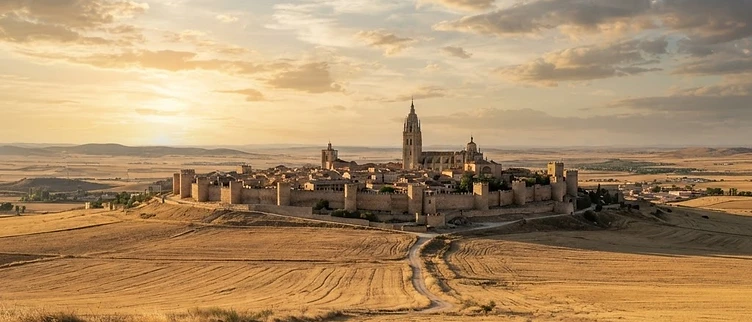
The largest region in Spain, and the one that most rewards a car: a plateau of walled cities, Romanesque churches and vineyards, with Salamanca, León, Burgos and Segovia as four genuine anchors spread across four hundred kilometres. There is no coast and the distances are real — the region is larger than Portugal — so the decision is not what to see but which half to take. The north (León, Burgos, the Camino) and the south (Salamanca, Ávila, Segovia) barely touch each other.
How long this region actually takes
Five days buys two cities and the driving between them. Ten days lets you take both halves properly and add either the Douro vineyards or the villages of the Sierra de Francia.
Where to put your nights
Spain Field Guide may earn a commission when you book through selected links. Recommendations are editorial and independent of commission.
The questions that decide the trip
None. This is the interior at its most interior, and the nearest sea is two and a half hours north in Asturias.
None. Rivers and reservoirs instead — the Duero gorge at the Arribes, and swimming in the Porma and the Esla in summer.
Roast lamb and suckling pig from a wood oven, which Segovia, Soria and Aranda de Duero do better than anywhere else in Spain; Ribera del Duero and Rueda wines; morcilla from Burgos; cecina from León; sheep's cheese from Zamora and the Páramo. Order the whole roast, not a slice.
Romanesque churches beyond counting, the Gothic cathedrals of León, Burgos, Salamanca and Segovia, the Roman walls of Ávila and Astorga, and Las Médulas, where the Romans took a mountain apart for gold.
Workable but limiting. Salamanca, León, Burgos, Segovia and Ávila all have good rail links from Madrid and between each other, but the monasteries, wine country and village architecture that make the region special effectively require a car.
Everything that matters: the Arribes gorge, the Sierra de Francia's stone villages, the Camino's Romanesque churches, Las Médulas and the Bierzo vineyards.
May, June and September. Spring is green and the cities are manageable; September brings harvest and warmth without the meseta's July heat.
July and August on the plateau, when 38 degrees is normal; Holy Week in Salamanca and Valladolid unless you have booked months ahead; and any plan that tries to see both halves in under a week.
Where Castilla y León gets compared
Experiences worth booking ahead
Spain Field Guide may earn a commission when you book through selected links. Recommendations are editorial and independent of commission.
Everywhere in Castilla y León
- Aldeadávila de la Ribera
- Aranda de Duero
- Arribes del Duero
- Astorga
- Ávila
- Burgos
- Carrión de los Condes
- Castrojeriz
- Covaleda
- Covarrubias
- Fermoselle
- Frómista
- La Alberca
- León
- Lerma
- Miranda del Castañar
- Mogarraz
- Peñafiel & Wine Museum
- Ponferrada
- Sahagún
- Salamanca
- San Martín del Castañar
- Segovia
- Sierra de Francia
- Sierra de Urbión
- Urueña
- Villafranca del Bierzo
- Vinuesa
- Alcázar de Segovia
- Atapuerca Archaeological Site
- Basílica de San Isidoro
- Burgos Cathedral
- Casa de las Conchas
- Catedral de Zamora
- Convento de San Esteban
- Iglesia de la Vera Cruz
- Iglesia de San Pablo
- Iglesia de Santa María la Antigua
- La Clerecía
- Laguna Negra de Urbión
- León Cathedral
- Muralla de Ávila
- Old & New Cathedrals of Salamanca
- Plaza Mayor de Salamanca
- Roman Aqueduct of Segovia
- Roman Bridge of Salamanca
- Santo Domingo de Silos
- Segovia Cathedral
- University of Salamanca
The other regional guides
Turn Castilla y León into an actual itinerary
You've decided how long the region needs. Travel Itinerary Co takes the places you saved here and sequences them into days, with driving times and overnights attached.
Build this into a tripContinues on Travel Itinerary Co