Castilla-La Mancha
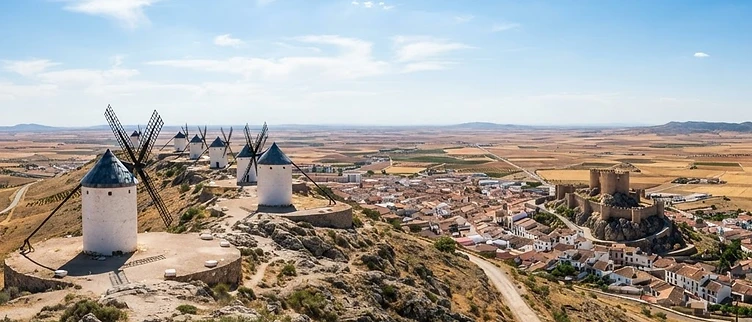
The picture-book Spain: flat horizons, windmills on ridges, and Toledo and Cuenca at either end of it, both built on such improbable ground that the towns themselves are the attraction. Toledo carries the weight of three religions and the best El Greco anywhere; Cuenca has the hanging houses and one of the country's oddest museums. Between them, La Mancha is plain, hot and genuinely rural, with food far better than its reputation.
Where to put your nights
Spain Field Guide may earn a commission when you book through selected links. Recommendations are editorial and independent of commission.
The questions that decide the trip
No sea, but Las Lagunas de Ruidera is a chain of spring-fed lakes with swimming and campsites, and the only water in the region worth planning around.
Manchego cheese and the sheep it comes from; saffron from Consuegra; pisto, migas, morteruelo and duelos y quebrantos. Game and lamb around Toledo, and the wines of Valdepeñas and La Mancha, which are far better than they were twenty years ago.
Toledo is an entire city of it — Visigothic, Moorish, Jewish and Christian layers in a few square kilometres, plus the cathedral and El Greco's paintings in the buildings they were made for. Elsewhere: the Roman site of Segóbriga, the castles at Belmonte and Sigüenza, and the windmills Cervantes made immortal.
Toledo and Cuenca both have high-speed rail from Madrid, and Ciudad Real is a short hop from Toledo. Consuegra, Almagro and Ruidera have buses from Madrid or Ciudad Real but slowly, and the lagunas need a car to reach at all.
The windmill ridges, the Lagunas de Ruidera, Almagro, and the northern sierra road through Sigüenza. Rural La Mancha is a country of villages and dirt roads; the train only touches the edges of it.
April, May and October. Toledo and Cuenca in July and August are unpleasant by eleven in the morning, and the plain is hotter still. The saffron harvest is late October, and the rose festival at Consuegra, when the flowers are picked, falls at the end of the month.
Midday in July and August, and Corpus Christi week in Toledo if you dislike crowds — the city is at its fullest then, and prices follow.
Five days in Castilla-La Mancha
Where Castilla-La Mancha gets compared
Experiences worth booking ahead
Spain Field Guide may earn a commission when you book through selected links. Recommendations are editorial and independent of commission.
Everywhere in Castilla-La Mancha
The other regional guides
Turn Castilla-La Mancha into an actual itinerary
You've decided how long the region needs. Travel Itinerary Co takes the places you saved here and sequences them into days, with driving times and overnights attached.
Build this into a tripContinues on Travel Itinerary Co