Iglesia de Santo Tomé
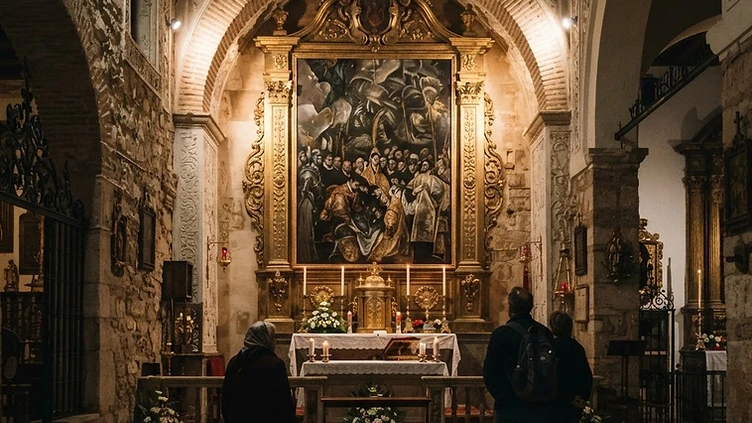
The El Greco is the whole point and it justifies the ticket: the Burial of the Count of Orgaz still hangs in the church it was painted for, in the position it was painted for. Twenty minutes of looking, then San Román two doors along.
A Mudéjar parish church in Toledo whose wall holds El Greco's Burial of the Count of Orgaz, painted in 1586 for this exact spot — the single best reason to give Toledo its own day.
At a Glance
Hidden in the labyrinthine alleys of the old city, this Mudéjar structure serves as a quiet vessel for El Greco’s masterpiece, The Burial of the Count of Orgaz. Visitors press into the small space to see the canvas, where the stark contrast of divine light and mortal shadow feels magnified by the surrounding brickwork. The atmosphere is solemn, focused entirely on the swirling colors of the painting that captures the city’s complex history.
How it got here
Toledo draws its character from layers of Roman, Visigothic, and Islamic occupations, culminating in the 1085 Christian reconquest. The parish of Santo Tomé traces its origins to a twelfth-century mosque mentioned in early records, which was converted to Christian use shortly after the city fell to Alfonso VI. The present fourteenth-century tower stands as a representative work of Toledo’s Mudéjar builders, who used brick and ceramic tile to create patterns under Christian patronage. El Greco moved into a house nearby in the sixteenth century and eventually accepted the commission for The Burial of the Count of Orgaz, painting the work to honor a benefactor of the church.
Where it sits
The old city sits on a granite crag surrounded on three sides by a deep gorge of the Tagus River. Narrow streets wind through this high ground, creating a dense thicket of stone and brick that keeps the interior spaces cool against the harsh sun of the central plateau. In summer, the heat reflects off the canyon walls while winter brings biting winds across the exposed mesa. Most travelers arrive from the north by train or road, entering a space where the medieval plan dictates movement and prevents the use of modern vehicles through much of the city center.
What to eat and drink
Toledo cooking relies on the game birds and mountain herbs of the surrounding Montes de Toledo. Perdiz estofada, partridge braised with garlic and bay leaves until the meat falls from the bone, defines the local table. Venison also appears frequently, often prepared in heavy, slow-cooked stews. Dessert means mazapán, a dense, centuries-old confection of ground almonds and sugar that persists as the signature of the city. Diners often finish a meal with a glass of local red wine from the La Mancha plateau, which provides the dark, dry profile necessary to balance the weight of the game.
Castilla-La Mancha: the whole region
The picture-book Spain: flat horizons, windmills on ridges, and Toledo and Cuenca at either end of it, both built on such improbable ground that the towns themselves are the attraction. Toledo carries the weight of three religions and the…
Minimum 4 days · better 6-7 days · deep 10 days
What's Nearby


In Castilla-La Mancha




In Castilla-La Mancha



Logistics are verified only. We don't publish schedules we haven't confirmed.
Experiences worth booking ahead
- Toledo Tour & Vineyard Experience with Wine Tasting from Madrid4.9 (3,064)8 hrsFrom €75
- Three Cities in One Day: Segovia, Avila and Toledo from Madrid4.8 (11,417)12 hrsFrom €76
- From Madrid: Toledo & Segovia Day Tour with Lunch & Tickets4.6 (6,007)11 hrsFrom €38
- Toledo Half or Full Day Tour with Optional Lunch from Madrid4.5 (6,354)From €29
Spain Field Guide may earn a commission when you book through selected links. Recommendations are editorial and independent of commission.
Ready to build Iglesia de Santo Tomé into a trip?
You've found a place worth going. When you're ready to turn discovery into an itinerary, Travel Itinerary Co picks up where the Field Guide leaves off — with your saved places already in hand.
Build this into a tripContinues on Travel Itinerary Co
Spain Field Guide may earn a commission when you book through selected links. Recommendations are editorial and independent of commission.