Corpus Christi de Toledo

If your Toledo visit happens to coincide with Corpus Christi, you've lucked into the city's best day.
To see Toledo at its most ceremonial, in a procession that's been running the same way for centuries.
At a Glance
- — You're not in Toledo that week
- — Processions aren't your thing
Corpus Christi is Toledo's main festival, the Thursday after Trinity Sunday (late May or June), and it's the most important civic-religious event in a city that takes its festivals seriously. The cathedral's monstrance — the gold Custodia de Enrique de Arfe — is carried through streets that have been carpeted with herbs and flowers and roofed over with awnings for the route. There's a procession of the city's confraternities, the Archbishop, and the civic authorities, and the old town is at its most decorative. It's a quieter, more medieval festival than the southern fiestas, and it fits Toledo's mood exactly.
How it got here
Toledo established this tradition following the papal decree of Urban IV in the thirteenth century. The event centers on the monstrance crafted by Enrique de Arfe between 1515 and 1524, a gold and silver structure weighing over 150 kilograms. This object became the focal point of a procession that links the ecclesiastical power of the cathedral to the secular life of the streets. The city layout dictates the pace of the event, as the narrow medieval corridors constrain the movement of the gilded monstrance. This annual movement reinforces the historical status of Toledo as the spiritual capital of the Spanish monarchy during the sixteenth century.
Where it sits
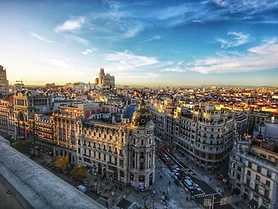
The city occupies a granite promontory carved by the Tagus river. Dry plateaus surround the old town, where the sun reflects off stone walls throughout the summer months. During the festival, heavy awnings hang above the streets to block the heat, creating a temporary roof over the path of the procession. The town consists of dense layers of brick and mortar that hold heat during the day and release it into the cool nights. Rain falls rarely in late spring, leaving the winding alleys dry for the arrival of the crowds that fill the stone plazas.
What to eat and drink
Toledo cuisine relies on game and the produce of the surrounding plains. Perdiz a la toledana, partridge braised with garlic, bay leaves and vinegar, occupies the center of the table. Deer and wild boar arrive from the nearby Montes de Toledo. Marzipan, made from almonds and sugar, fills the confectioneries throughout the year. For dessert, locals consume tortas de Alcázar, thin sponge cakes soaked in syrup. Meals conclude with a glass of anise-flavored spirit or a local red wine from the dry vineyards of the La Mancha plateau, which provide high alcohol content to match the heavy, slow-cooked meat dishes.
Castilla-La Mancha: the whole region
The picture-book Spain: flat horizons, windmills on ridges, and Toledo and Cuenca at either end of it, both built on such improbable ground that the towns themselves are the attraction. Toledo carries the weight of three religions and the…
Minimum 4 days · better 6-7 days · deep 10 days

Pair It With

In Castilla-La Mancha




In Castilla-La Mancha





Experiences worth booking ahead
- Toledo Tour & Vineyard Experience with Wine Tasting from Madrid4.9 (3,063)8 hrsFrom €75
- Three Cities in One Day: Segovia, Avila and Toledo from Madrid4.8 (11,401)12 hrsFrom €76
- From Madrid: Toledo & Segovia Day Tour with Lunch & Tickets4.6 (5,994)11 hrsFrom €38
- Toledo Half or Full Day Tour with Optional Lunch from Madrid4.5 (6,353)From €29
Spain Field Guide may earn a commission when you book through selected links. Recommendations are editorial and independent of commission.
Ready to build Corpus Christi de Toledo into a trip?
You've found a place worth going. When you're ready to turn discovery into an itinerary, Travel Itinerary Co picks up where the Field Guide leaves off — with your saved places already in hand.
Build this into a tripContinues on Travel Itinerary Co
Spain Field Guide may earn a commission when you book through selected links. Recommendations are editorial and independent of commission.