Navarra
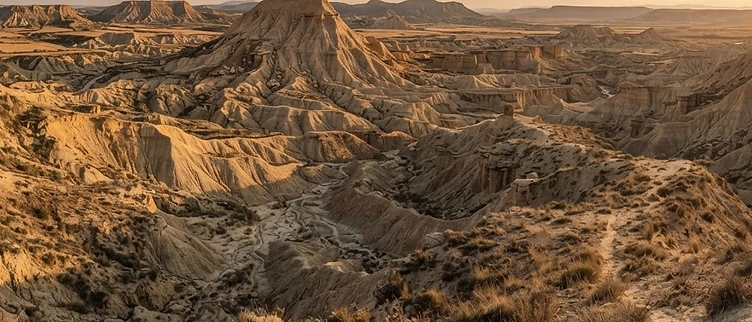
A region of contrasts packed into a small space: Pyrenean valleys and Atlantic beech forest in the north, Pamplona in the middle, and the Bardenas Reales — a desert of eroded badlands — in the south-east, which nobody expects at this latitude. It is also Camino country, with the best-preserved stretch running from Roncesvalles to Puente la Reina. The trade is that the north is wet, the south is hot, and the two are ninety minutes apart.
How long this region actually takes
Three days is Pamplona and the Bardenas. Five or six adds the Camino towns and the beech woods of the north, which are a genuinely different climate and landscape from the rest of the region.
Where to put your nights
Spain Field Guide may earn a commission when you book through selected links. Recommendations are editorial and independent of commission.
The questions that decide the trip
None. Navarra runs from the Pyrenees down to the Ebro, and it is the Ebro that forms its southern edge.
None — rivers and reservoirs instead, and the Nacedero del Urederra, which is a spring-fed pool rather than a swimming spot.
Vegetables of the Ebro valley, above all piquillo peppers and asparagus; lamb cooked with peppers as cordero al chilindrón; Roncal and Idiazábal cheeses; and Navarra's rosados, the original rosé of Spain and still the benchmark.
Pamplona's cathedral and fortifications, the Romanesque church of Santa María de Eunate standing alone on the Camino, Roncesvalles where the pilgrimage enters Spain, and the royal palace at Olite, a castle built as a residence that still reads like one.
Pamplona is on the high-speed line from Madrid and Barcelona, and everything radiates from there by bus. The Bardenas, the Urederra and the northern valleys are car or long taxi rides; there is no useful rail network inside the region.
The Bardenas Reales, which has a network of restricted tracks you drive yourself; the Urederra and the beech woods of the Urbasa; and the border valleys of the north. Without a car, most of this is invisible.
May and June, then September and October. The Bardenas is best in spring, when the desert flowers, and unbearable at midsummer. The north is green and wet from October to April, with snow above 1,000 metres.
The week of San Fermín in July unless that is precisely what you came for — prices triple and bookings disappear a year ahead. Also the Bardenas at midday in July and August.
Five days in Navarra
Two nights in Pamplona, taking in the cathedral and a day on the Camino to Puente la Reina and Eunate; then south for two nights around Olite, with the palace, the Urederra if you book a permit, and a full day driving the Bardenas Reales at first light.
Where Navarra gets compared
Experiences worth booking ahead
Spain Field Guide may earn a commission when you book through selected links. Recommendations are editorial and independent of commission.
Everywhere in Navarra
The other regional guides
Turn Navarra into an actual itinerary
You've decided how long the region needs. Travel Itinerary Co takes the places you saved here and sequences them into days, with driving times and overnights attached.
Build this into a tripContinues on Travel Itinerary Co