Basílica de San Isidoro
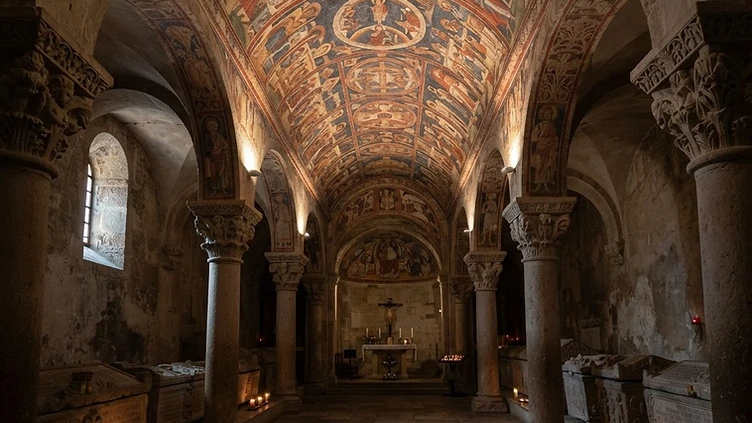
Go straight for the Panteón de Reyes: the 12th-century frescoes in that low, dark chamber are the finest Romanesque painting in Spain, and the museum ticket covers them. An hour, on the walk between the cathedral and the Gaudí house opposite.
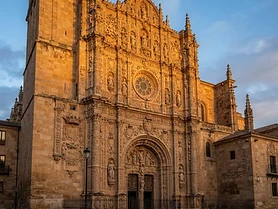
The royal collegiate of León, whose Romanesque portal opens onto the Panteón de Reyes — a small painted chamber of kings and queens, and the reason people reach for the Sistine Chapel comparison.
At a Glance
The Panteón de Reyes holds 12th-century frescoes whose ochres and reds have survived largely intact, and the room is often called the Sistine Chapel of the Romanesque. The low, barrel-vaulted ceiling forces a bent posture on everyone who enters. Stone keeps the space cool, and the quiet lets you study the zodiac and biblical scenes without distraction.
How it got here
Ferdinand I and Sancha of León founded the collegiate church in the eleventh century over the site of a previous pre-Romanesque structure. The current building follows the expansion commissioned by Sancha of León and Urraca of Zamora. Its burial vault contains the remains of the monarchs of the Kingdom of León who governed the surrounding territory during the Reconquista. The Romanesque painting in the burial chamber dates to the twelfth century under the patronage of Sancha Raimúndez. These frescoes escaped major damage during the Peninsular War when French soldiers used the vault as a stable. The collegiate church operates under the foundation of the royal house.
Where it sits
The city stands on a high plateau at the confluence of the Bernesga and Torío rivers where the northern plains meet the foothills of the Cantabrian Mountains. Winters bring sharp frost from the mountains and the damp chill of the plateau wind. Summer heat clears by dusk as the mountain air moves through the narrow streets. The city serves as a gateway to the mining basins and the mountain passes leading toward Asturias. Stone masonry defines the older districts and the surrounding landscape consists of high cereal fields that transition into the scrub oak of the mountain base.
What to eat and drink
Cecina de León, a cured beef heart salted and smoked over oak, provides the base for many local meals. Morcilla de León, a blood sausage made with plenty of onion and spices, appears on nearly every plate in the cooler months. For a hearty meal, look for cocido maragato, a stew served in reverse with the chickpeas and vegetables appearing before the meats. Pair these heavy dishes with bold red wines from the Bierzo region made from the Mencía grape, which thrive in the slate soils of the nearby valleys to the west.
Castilla y León: the whole region
The largest region in Spain, and the one that most rewards a car: a plateau of walled cities, Romanesque churches and vineyards, with Salamanca, León, Burgos and Segovia as four genuine anchors spread across four hundred kilometres. There…
Minimum 5 days · better 8-10 days · deep 2 weeks

In Castilla y León



In Castilla y León





In Castilla y León










Logistics are verified only. We don't publish schedules we haven't confirmed.
Experiences worth booking ahead
Spain Field Guide may earn a commission when you book through selected links. Recommendations are editorial and independent of commission.
Ready to build Basílica de San Isidoro into a trip?
You've found a place worth going. When you're ready to turn discovery into an itinerary, Travel Itinerary Co picks up where the Field Guide leaves off — with your saved places already in hand.
Build this into a tripContinues on Travel Itinerary Co
Spain Field Guide may earn a commission when you book through selected links. Recommendations are editorial and independent of commission.