Convento de San Esteban
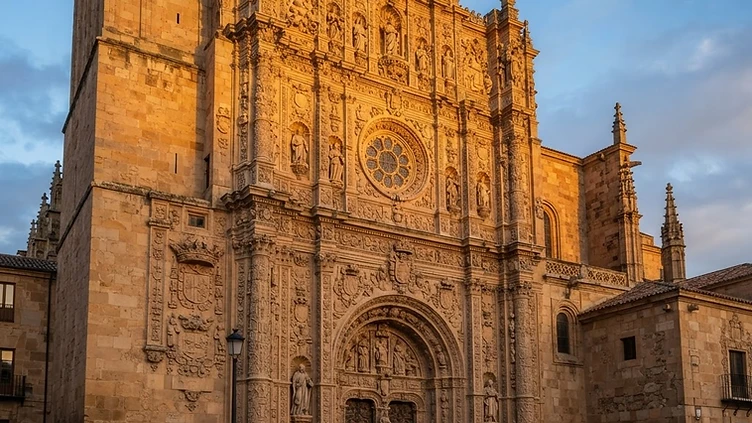
Go for the facade and the cloister: the Plateresque carving is the finest stonework in Salamanca, and the Dominican house behind it is where Columbus argued for his western route. Visits run at set times, so check before you walk over.
A Dominican convent whose Plateresque front is carved as a giant stone altarpiece, and the house where Columbus argued for a westward crossing before the Salamanca scholars.
Plaza Mayor de Salamanca · Old & New Cathedrals of Salamanca · La Clerecía
At a Glance
The facade of this Dominican convent is a dense, intricate thicket of stone carvings so finely rendered they resemble hammered silver more than masonry. It is a dizzying display of Plateresque ambition that towers over the street, demanding a long look to parse the saints and symbols hidden in the rock. Inside, the hushed cloisters provide a meditative contrast to the elaborate showmanship of the exterior, maintaining a sense of monastic enclosure that has persisted for centuries.
How it got here
Dominicans established a presence in Salamanca during the thirteenth century and secured the site for this convent through royal patronage in the fifteenth. The current structure replaced an earlier building, drawing heavily on the wealth of the order during the height of Spain's academic and theological prominence in the city. Construction spanned several decades, moving through successive architectural transitions that cemented the convent as a locus of the Counter-Reformation. Intellectual activity defined these cloisters for generations, as the convent linked the Dominican intellectual tradition directly to the university life that shaped the city into a bastion of Castilian scholasticism.
Where it sits
Salamanca sits on a bend of the Tormes River, surrounded by the high, dry plains of the northern Meseta. The city is built from Villamayor sandstone, a material that turns a warm, burnished gold in the evening light. Winters bring biting winds from the Sierra de Francia, while summers bake the stone streets until long after sunset. The convent stands near the university quarter, an area marked by heavy masonry and narrow lanes that funnel the heat and cold. Mornings bring a quiet cadence to the cloisters, even as the nearby public squares swell with students and travelers.
What to eat and drink
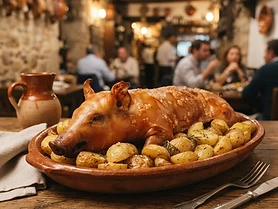
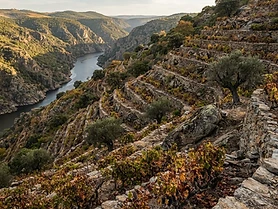
Castilian kitchens favor slow-roasted meats and pulses. Hornazo, a savory pie stuffed with chorizo, loin, and hard-boiled eggs, is the traditional staple for spring festivities. Farinato, a rustic sausage made from breadcrumbs, pork fat, and paprika, appears frequently in local tapas. Legumes define the pantry, particularly the dark, tender chickpeas from nearby Pedrosillo el Ralo. Meals rely on the dry wines of the Arribes del Duero, where the river carves deep canyons into the granite landscape along the border with Portugal. These acidic, mineral-heavy reds cut through the richness of local roast suckling pig or lamb.
Castilla y León: the whole region
The largest region in Spain, and the one that most rewards a car: a plateau of walled cities, Romanesque churches and vineyards, with Salamanca, León, Burgos and Segovia as four genuine anchors spread across four hundred kilometres. There…
Minimum 5 days · better 8-10 days · deep 2 weeks
What's Nearby


In Castilla y León



In Castilla y León





In Castilla y León










Logistics are verified only. We don't publish schedules we haven't confirmed.
Experiences worth booking ahead
Spain Field Guide may earn a commission when you book through selected links. Recommendations are editorial and independent of commission.
Ready to build Convento de San Esteban into a trip?
You've found a place worth going. When you're ready to turn discovery into an itinerary, Travel Itinerary Co picks up where the Field Guide leaves off — with your saved places already in hand.
Build this into a tripContinues on Travel Itinerary Co
Spain Field Guide may earn a commission when you book through selected links. Recommendations are editorial and independent of commission.