Vía de la Plata
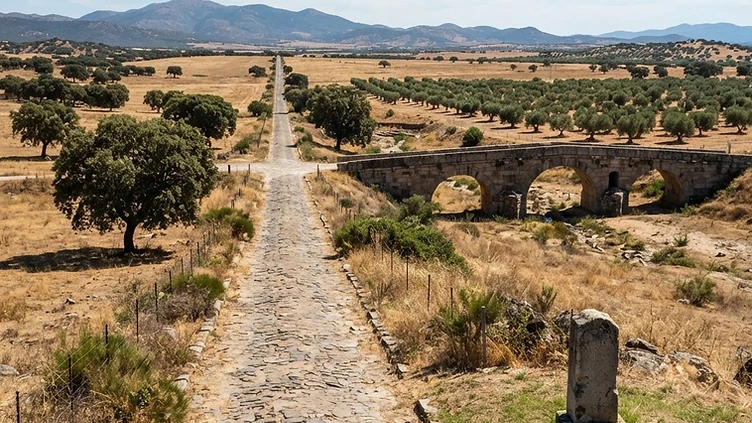
The Vía de la Plata is the Camino for solitude and endurance. It's a serious undertaking — long stages between services, brutal summer heat, and weeks alone on Roman roads — and one of the most rewarding walks in Spain for the prepared.
The great southern Camino — a Roman road turned pilgrimage, 1000 km from Sevilla through Extremadura's dehesas and into Galicia. The longest, loneliest, hottest route, with deep history and almost no crowds.
At a Glance
- — You're walking in summer (brutal heat)
- — You want frequent pilgrim company
- — You need short days
The Vía de la Plata follows a 1000 km Roman road from Sevilla north to Santiago, through the dehesas of Extremadura and the plains of Castilla before climbing into Galicia. It's the longest Camino and, in summer, the hottest — most now walk it in spring or autumn. Stages between towns can be long and services sparse, so it suits self-sufficient long-distance walkers. The payoff is solitude, deep Roman and medieval history, and a completely different Spain than the green north. At Granja de Moreruela most walkers branch onto the Sanabrés variant to reach Santiago via Galicia's southeast.
How it got here
Augustus consolidated these routes during the expansion of the Roman Empire to link the silver mines of the north with the southern ports. Engineers laid stone causeways to facilitate the movement of troops and goods through the Iberian Peninsula. Following the fall of the empire the path persisted as a livestock drove road for transhumance. While other routes to Santiago de Compostela grew through medieval religious devotion this path maintained its primary function for local movement. The modern resurgence relies on the structural remains of these Roman milestones and bridge foundations which anchor the route through the distinct historic shifts of the Spanish interior.
Where it sits
The path crosses the expanse of the southern meseta where arid plains give way to the holm oak forests of the dehesa. These landscapes shift from the heat of the Andalusian sun through the rugged scrubland of Extremadura and into the rolling hills of the north. Movement slows during the height of summer as the sun dominates the open terrain. Most people time their transit for the spring or autumn months when the climate becomes bearable for long journeys. The route crosses vast tracts of private land where the horizon dominates the view and human settlements appear only at wide intervals.
What to eat and drink
The culinary traditions follow the shifting landscapes of the route. Extremadura provides jamón ibérico from pigs fattened on the acorns of the dehesa forests. Throughout the journey one encounters migas, a preparation of fried breadcrumbs flavored with garlic and chorizo that sustains rural laborers. Stews of chickpeas or lentils often appear on tables in the plains of Castilla. Locally produced wines from the diverse provinces line the route, typically red and robust to match the caloric demands of travel. Fruit and simple cheeses appear when crossing into the cooler northern territories as the heavy grain staples of the south recede.
Pair It With



Logistics are verified only. We don't publish schedules we haven't confirmed.
Ready to build Vía de la Plata into a trip?
You've found a place worth going. When you're ready to turn discovery into an itinerary, Travel Itinerary Co picks up where the Field Guide leaves off — with your saved places already in hand.
Build this into a tripContinues on Travel Itinerary Co
Spain Field Guide may earn a commission when you book through selected links. Recommendations are editorial and independent of commission.