Cuacos de Yuste

Worth more than the monastery it serves: eat here rather than at the monument, and walk up rather than drive.
A stone village with water running down the streets, ten minutes below Charles V's retirement.
At a Glance
- — You are here in August, when the whole valley is on holiday at once
Cuacos de Yuste is a stone village at the foot of the monastery road, with flowered balconies, a Plaza Mayor with a jet fountain in the middle and water running in channels along the streets. It is the most comfortable place in La Vera to spend an afternoon: there are two or three very good restaurants, a couple of small hotels, and the gorge of La Olla above the village where the stream pools and you can swim in summer. The monastery of Yuste is two kilometres up the hill, which is why most people are here at all — but the village is worth the stop on its own, and the eating is better than at the monument.
How it got here
The village grew in the shadow of the Monastery of Yuste, which became a final refuge for Charles V. After abdicating his titles in 1556, the former Holy Roman Emperor chose this remote corner of La Vera for his retirement. The proximity to the royal residence brought traffic and resources to the hillside settlement. Decades later, the village endured the turmoil of the Peninsular War when French troops caused destruction in the surrounding province. The architecture preserves the traditional timber-framed construction of the region, where stone bases carry upper floors that overhang the narrow streets to manage the steep slope of the Sierra de Gredos.
Where it sits
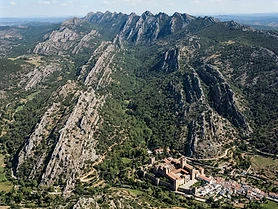
The village clings to the southern slope of the Sierra de Tormantos, a spur of the wider Gredos range. Water from the mountain peaks flows through stone channels beside the house walls and feeds the gorge of La Olla. Winters bring heavy rains that turn the slopes into a dense green, while summers dry the lower scrub to a pale gold. The road climbs sharply from the plains of the Tiétar river valley, winding through chestnut and oak forests. It stays quiet until the peak of summer when the high altitude pools draw travelers from the hotter southern plains.
What to eat and drink
The pantry of La Vera relies on the pimentón de la Vera, a smoked paprika produced from dried peppers grown in the surrounding valley. Local kitchens serve caldereta de cabrito, a kid goat stew simmered with garlic and this signature paprika. Migas extremeñas, broken bread fried with fat and cured meats, appear regularly as a midday staple. The proximity to the mountains keeps the local palate focused on pork products from the dehesa and river trout caught in the nearby streams. Dry red wines from the Ribera del Guadiana provide the standard pairing for these dense, mountain-focused meals.
Extremadura: the whole region
The emptiest region in Spain, and the one where the scale of the country is clearest: dehesa plains running to the horizon in every direction, hilltop towns built from the stone under them, and the best Roman remains in the country at…
Minimum 4 days · better 7-8 days · deep 12 days


In Extremadura


In Extremadura




Logistics are verified only. We don't publish schedules we haven't confirmed.
Experiences worth booking ahead
Spain Field Guide may earn a commission when you book through selected links. Recommendations are editorial and independent of commission.
Ready to build Cuacos de Yuste into a trip?
You've found a place worth going. When you're ready to turn discovery into an itinerary, Travel Itinerary Co picks up where the Field Guide leaves off — with your saved places already in hand.
Build this into a tripContinues on Travel Itinerary Co
Spain Field Guide may earn a commission when you book through selected links. Recommendations are editorial and independent of commission.