Trevejo
Two hours, including the climb. Do not attempt it in the middle of a hot day.
The best viewpoint in the Sierra de Gata, and a ruin you can walk around freely.
At a Glance
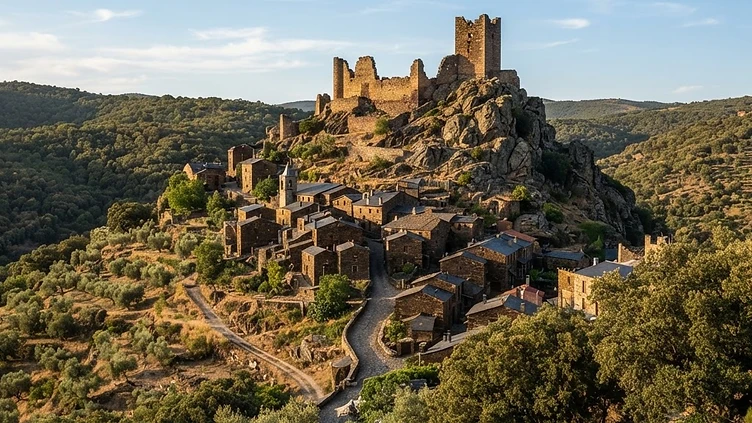
Trevejo is barely a village — a handful of houses below a rock outcrop carrying the ruins of a fourteenth-century castle, reached by a short, steep walk. The castle is the point: a walled enclosure and a tower stranded above the valley, with a view over the whole Sierra de Gata and into Portugal. In summer the local festival and the goat fairs still bring people up. There is nowhere to stay and nowhere to eat; park, walk up, and take your time on the rock.
How it got here
The castle at Trevejo once guarded the frontier between the Kingdom of León and the Muslim territories of the south. It belonged to the Order of the Hospital of Saint John of Jerusalem during the Middle Ages. The fortress saw action throughout the dynastic conflicts of the fourteenth and fifteenth centuries between the crowns of Castile and Portugal. Its strategic value vanished as these borders solidified and the importance of the Sierra de Gata as a military march faded. The stone structures today endure as silent witnesses to the territorial shifts that defined the creation of the modern Spanish state.
Where it sits
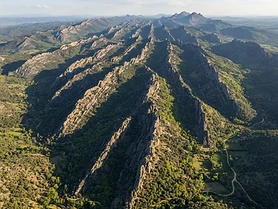
The village sits on a granite outcrop within the Sierra de Gata, a rugged mountain range that drops toward the Portuguese border. Granite boulders and dense oak scrub define the landscape. Thin roads wind through narrow valleys and chestnut groves to reach the village from the direction of Moraleja. Summer heat dries the hillsides while winter brings frequent mountain mist and cold winds. The pace of life slows to a crawl between the grey stone walls. Solitude prevails here, broken only by the movement of local livestock and the occasional walker wandering the rock paths.
What to eat and drink
Traditional cooking here relies on the products of the mountain pastures. Caldereta de cabrito, a slow-cooked stew of goat kid with onion, garlic, and dried peppers, provides sustenance against the mountain chill. Jamón ibérico from pigs fattened on local acorns defines the palate of Extremadura. The cuisine includes simple preparations of trout pulled from mountain streams and wild mushrooms gathered in the autumn forests. Dry, acidic red wines produced in the nearby hills wash down heavy plates of meat. Dried figs and honey often finish the meal, reflecting the ancient orchards that line the valley floors below the village.
Extremadura: the whole region
The emptiest region in Spain, and the one where the scale of the country is clearest: dehesa plains running to the horizon in every direction, hilltop towns built from the stone under them, and the best Roman remains in the country at…
Minimum 4 days · better 7-8 days · deep 12 days
In Extremadura


In Extremadura





Other Worth a Detour in Extremadura



Logistics are verified only. We don't publish schedules we haven't confirmed.
Experiences worth booking ahead
Spain Field Guide may earn a commission when you book through selected links. Recommendations are editorial and independent of commission.
Ready to build Trevejo into a trip?
You've found a place worth going. When you're ready to turn discovery into an itinerary, Travel Itinerary Co picks up where the Field Guide leaves off — with your saved places already in hand.
Build this into a tripContinues on Travel Itinerary Co
Spain Field Guide may earn a commission when you book through selected links. Recommendations are editorial and independent of commission.