Praia de Carnota

Galicia's longest beach is exactly the kind of wild, empty Atlantic coast that rewards the trip out here.
Miles of open sand back into dunes and a village with Galicia's longest hórreo — big surf, big sky, minimal development.
At a Glance
- — calm swimming
- — you want facilities
- — short visits only
Miles of open sand back into undulating dunes, creating a sense of scale that is rare for this part of the Atlantic coast. The nearby village is famous for having the longest hórreo in Galicia, and the whole area remains remarkably free of heavy tourist development. It is a raw, windy, and quiet place that rewards those willing to put in the travel time.
How it got here
Galicia emerged as a distinct maritime culture through the interplay of Atlantic trade and isolationist geography. The coastline of A Coruña provided deep estuaries that facilitated early fishing settlements, while the inland mountains restricted transit. These conditions fostered a rural society built on shared land and the storage of grain in granite hórreos. Carnota sits within this tradition, where communal farming sustained isolated coastal parishes for generations. The development of the village reflects a reliance on agricultural production alongside artisanal maritime activities, preserving the architectural forms of a pre-industrial era that shaped the social structure of this corner of the Iberian Peninsula.
Where it sits
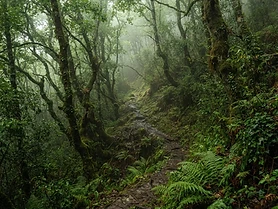
The terrain transitions from granite peaks toward a vast tidal zone where the Atlantic meets the salt marshes. Strong currents and winds clear the sky, exposing long stretches of white quartz sand to the elements. During autumn and winter, the mist rolls off the ocean to settle over the marshes, while summer light defines the sharp edges of the dunes and the distant island silhouette. Access requires navigating narrow roads that wind through small parish clusters. The landscape stays quiet, lacking the large infrastructure found in larger ports to the north, keeping the rhythm of the tides primary.
What to eat and drink
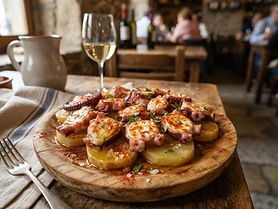
Pulpo á feira stands as the foundation of the coastal diet, octopus boiled in copper cauldrons, sliced, and finished with olive oil, salt, and pimentón. The produce of the Rías includes empanada gallega, a dense pastry filled with scallops, cockles, or seasoned cod. For heavier meals, caldo gallego provides a base of cabbage, potatoes, white beans, and lard, frequently paired with a slice of bread made from local maize. Albariño, a crisp white wine with high acidity from the nearby vineyards, cuts through the salt and fat of the shellfish that define every meal.
Galicia: the whole region
Galicia is wet, green, cheap and unlike anywhere else in Spain: a drowned coast of rias, granite villages, seafood that justifies the trip on its own, and Santiago at the middle of it. The rain is not a risk, it is a certainty — plan…
Minimum 5 days · better 8-10 days · deep 2 weeks

Pair It With

In Galicia




In Galicia


In Galicia





Logistics are verified only. We don't publish schedules we haven't confirmed.
Ready to build Praia de Carnota into a trip?
You've found a place worth going. When you're ready to turn discovery into an itinerary, Travel Itinerary Co picks up where the Field Guide leaves off — with your saved places already in hand.
Build this into a tripContinues on Travel Itinerary Co
Spain Field Guide may earn a commission when you book through selected links. Recommendations are editorial and independent of commission.