Monasterio de San Martiño Pinario
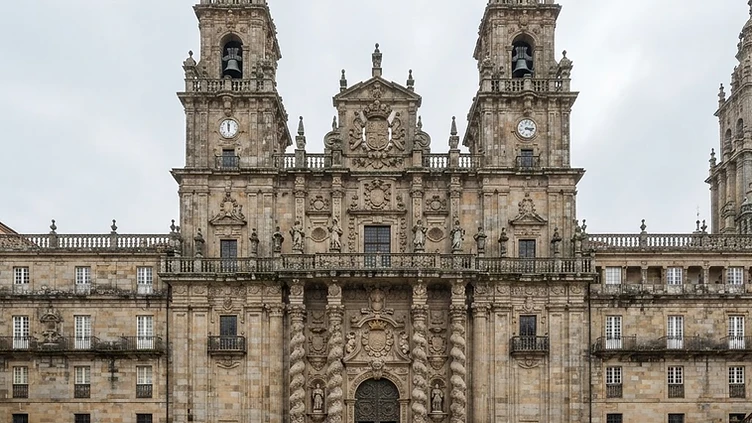
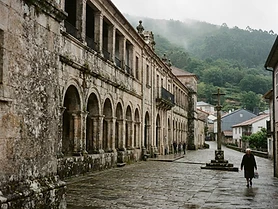
Almost nobody goes in, which is the argument for it: step inside around Mass and see a Benedictine church scaled like a cathedral. The facade and its paired towers give you the best free view in Santiago, straight across from the cathedral.
Spain's second-largest monastery, facing the cathedral across the Praza da Inmaculada — a Baroque mountain of granite whose church is still in daily use and whose scale is best read against the cathedral it answers.
At a Glance
Facing the cathedral square, this massive structure commands the plaza with a churrigueresque facade so ornate it makes the eyes ache under the afternoon sun. Inside, the sheer scale of the twin-squared cloister creates a dizzying geometry of shadow and light, dwarfing those who wander through its vaulted galleries. The scent of damp earth drifts in from the hidden gardens, cutting through the sterile silence of the enormous hallways. It is an overwhelming display of Baroque ambition that makes the surrounding city seem small, deliberate, and undeniably subordinate to the weight of its own history.
How it got here
Benedictine monks founded the monastery in the tenth century and directed its expansion as the influence of Santiago de Compostela grew. The site gained immense power through control of land across Galicia, eventually holding jurisdiction over numerous towns and villages. Architects reconstructed the structure during the seventeenth and eighteenth centuries to align with the scale of the nearby cathedral. The resulting stone mass tells of an era when monastic orders directed both the economic life of the province and the artistic direction of the city. Today the library and the high altarpiece persist as evidence of the resources the order extracted from the surrounding Galician countryside over several centuries.
Where it sits
The monastery dominates the northern edge of the medieval core of Santiago de Compostela. Rain defines the city, turning the granite of the plaza dark and slick through long winters. Mist rolls in from the Atlantic to settle between the narrow streets, while spring brings light that hits the stone facades with sharp intensity. Pilgrims arrive at the cathedral square daily, but the monastery maintains a separate, quiet weight. It faces the constant movement of the city from a position of detached permanence, anchored in the heavy soil and stone that compose the wider landscape of the province of A Coruña.
What to eat and drink
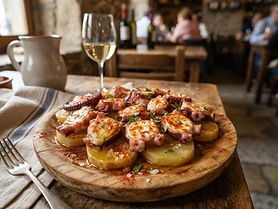
Galician tables prioritize the products of the coast and the small plots of the interior. Pulpo á feira, octopus boiled in copper pots and dressed with coarse salt, paprika, and olive oil, persists as the standard. Pimientos de Padrón, small green peppers fried until blistered, accompany almost every meal during the summer. To drink, order Albariño, a crisp white wine from the nearby Rías Baixas that cuts through the fat of local pork dishes. Tarta de Santiago, a dense almond cake dusted with powdered sugar, ends the meal, reflecting the long connection between the city and the legacy of the pilgrimage.
Galicia: the whole region
Galicia is wet, green, cheap and unlike anywhere else in Spain: a drowned coast of rias, granite villages, seafood that justifies the trip on its own, and Santiago at the middle of it. The rain is not a risk, it is a certainty — plan…
Minimum 5 days · better 8-10 days · deep 2 weeks
What's Nearby


In Galicia




In Galicia


In Galicia




Logistics are verified only. We don't publish schedules we haven't confirmed.
Appears In
Experiences worth booking ahead
- Excursion to Finisterre + Muxia + Costa da Morte (7 stops)4.8 (1,784)9.3 hrsFrom €52
- Day Trip from Porto to Santiago de Compostela and Valença4.8 (1,171)10 hrsFrom €79
- Private tours Santiago de Compostela : choose your option5.0 (151)From €52
- Santiago de Compostela: Finisterre, Muxía & Costa da Morte4.8 (276)9 hrsFrom €52
Spain Field Guide may earn a commission when you book through selected links. Recommendations are editorial and independent of commission.
Ready to build Monasterio de San Martiño Pinario into a trip?
You've found a place worth going. When you're ready to turn discovery into an itinerary, Travel Itinerary Co picks up where the Field Guide leaves off — with your saved places already in hand.
Build this into a tripContinues on Travel Itinerary Co
Spain Field Guide may earn a commission when you book through selected links. Recommendations are editorial and independent of commission.