Queso de Tetilla

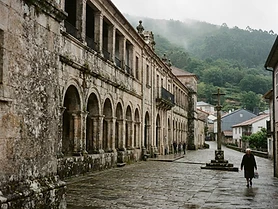
A young, mild cheese — find a market stall in Santiago selling it by the wedge with membrillo.
Galicia's creamy cow's-milk cheese, named for its conical 'little breast' shape, with a smooth, buttery, mildly tangy paste. Made from Frisona and Rubia Gallega milk, eaten with quince paste or melted over dishes.
At a Glance
- — You want strong, aged cheese
Instantly recognizable by its distinctive conical breast shape, this Galician cow's-milk cheese offers a smooth, buttery texture and a mild, tangy finish. It is crafted from the milk of Frisona and Rubia Gallega herds, resulting in a pale, semi-soft paste that melts beautifully. A wedge purchased at a stall in Santiago de Compostela is best paired with a generous spoonful of quince paste to balance the natural saltiness.
How it got here
Galicia emerged as a distinct pastoral territory where communal land rights favored smallholder dairy farming. The production of cheese grew out of subsistence agriculture practiced in the verdant coastal valleys and mountain slopes. Monastic orders managed many of the early grazing lands and solidified the focus on dairy cows over centuries. The specific shape of Tetilla evolved as a standard mold form used during the pressing process to ensure consistent moisture drainage. Modern regulations solidified the definition of the cheese in the twentieth century to protect the traditional methods from industrial imitation while ensuring that the milk supply remains restricted to the local Frisona and Rubia Gallega herds.
Where it sits
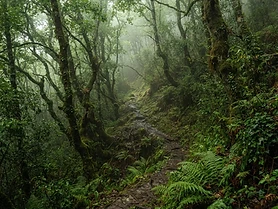
Deep green valleys and high granite ranges define the Galician landscape. Atlantic rains turn the pastures vibrant for much of the year, providing ample grass for cattle. Mist often clings to the slopes of the interior, dampening the stone walls of farmhouses and local village markets. Reaching these rural centers requires navigating narrow roads that wind through dense eucalyptus and pine stands. Winter brings cold dampness that keeps the pastures dormant, while the humid warmth of summer encourages rapid growth. The pace of life slows significantly outside of the larger coastal hubs, following the seasonal cycle of the dairy herds.
What to eat and drink
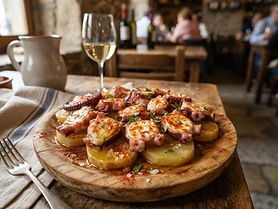
Tetilla defines the Galician cheese plate with its buttery texture and mild tang. It pairs well with membrillo, a firm quince paste that adds sweetness to the creamy saltiness of the curd. For a complete meal, order pulpo á feira, octopus boiled in copper pots and dressed with coarse salt, paprika, and olive oil. Wash these down with Albariño, a crisp white wine grown in the granite soils of the coastal vineyards. The acidity of the wine cuts through the richness of the cheese and the oil of the seafood, acting as a standard accompaniment at every local table.
Galicia: the whole region
Galicia is wet, green, cheap and unlike anywhere else in Spain: a drowned coast of rias, granite villages, seafood that justifies the trip on its own, and Santiago at the middle of it. The rain is not a risk, it is a certainty — plan…
Minimum 5 days · better 8-10 days · deep 2 weeks
What's Nearby


Pair It With


In Galicia


In Galicia


In Galicia





Logistics are verified only. We don't publish schedules we haven't confirmed.
Ready to build Queso de Tetilla into a trip?
You've found a place worth going. When you're ready to turn discovery into an itinerary, Travel Itinerary Co picks up where the Field Guide leaves off — with your saved places already in hand.
Build this into a tripContinues on Travel Itinerary Co
Spain Field Guide may earn a commission when you book through selected links. Recommendations are editorial and independent of commission.