O Berbés (Vigo)

Recommended for early risers. Ninety minutes here will change how you read every menu in Galicia.
To see a serious fishing economy at work, and to eat what came off the boat that morning.
Mussel Rafts of the Rías Baixas (Bateas) · A Guarda · Baiona
At a Glance
- — You are not willing to get up early
Vigo is one of the largest fishing ports in Europe by volume, and O Berbés is the working heart of it: boats alongside the quay, a market that runs on the night's catch, and an auction system in which prices are set by the trade rather than by a shopkeeper. Come in the morning to watch boxes come off the boats and to see the machinery of a real fishing economy. Around the corner, oyster stands open shells to order on the street. The fish here is not a display for visitors; it is the reason the city exists.
How it got here
Vigo grew from a small fishing settlement into a major industrial node because of the deep natural harbor provided by the Ría de Vigo. This coastline served as a strategic maritime gateway for centuries. The development of O Berbés as a concentrated hub for the fish trade reflects the expansion of the canning industry that transformed the provincial economy during the nineteenth and twentieth centuries. The current structure of the harbor relies on the infrastructure built during these industrial expansions. The port layout dictates the flow of people and goods, creating a rigid division between the maritime industrial zone and the hillside dwellings above the quay.
Where it sits
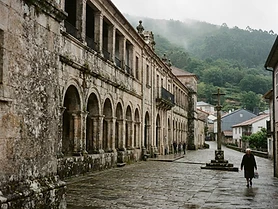
The granite slopes rise sharply from the water, forcing the city to cling to the steep edges of the ría. Cold Atlantic currents drive the marine climate, keeping winters damp and summers temperate. During the morning hours, the waterfront vibrates with the movement of forklifts and the sorting of catches under the covered sheds. Rain is a constant presence, scouring the stone architecture of the old quarter. Roads weave up from the harbor into the dense grid of the city center, connecting the high-volume industrial zone to the residential districts that look down upon the Atlantic traffic.
What to eat and drink
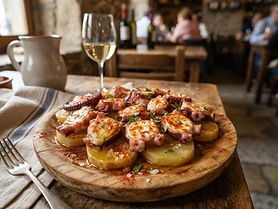
Oysters dominate the culinary identity of this quay, served raw at outdoor stalls by the women who open them to order. The region relies on the catch brought to the auction block, specifically hake and monkfish. Pulpo á feira, octopus boiled in copper pots and dressed with coarse salt, paprika, and olive oil, forms the core of the local diet. Diners pair these dishes with Albariño, a crisp, acidic white wine grown in the granite soils of the nearby Rías Baixas. These salty, seafood-heavy plates define the daily rhythm of the working waterfront and the surrounding coastal neighborhoods.
Galicia: the whole region
Galicia is wet, green, cheap and unlike anywhere else in Spain: a drowned coast of rias, granite villages, seafood that justifies the trip on its own, and Santiago at the middle of it. The rain is not a risk, it is a certainty — plan…
Minimum 5 days · better 8-10 days · deep 2 weeks
What's Nearby


Pair It With



In Galicia


In Galicia


In Galicia






Logistics are verified only. We don't publish schedules we haven't confirmed.
Appears In
Experiences worth booking ahead
Spain Field Guide may earn a commission when you book through selected links. Recommendations are editorial and independent of commission.
Ready to build O Berbés (Vigo) into a trip?
You've found a place worth going. When you're ready to turn discovery into an itinerary, Travel Itinerary Co picks up where the Field Guide leaves off — with your saved places already in hand.
Build this into a tripContinues on Travel Itinerary Co
Spain Field Guide may earn a commission when you book through selected links. Recommendations are editorial and independent of commission.