Monasterio de San Xulián de Samos
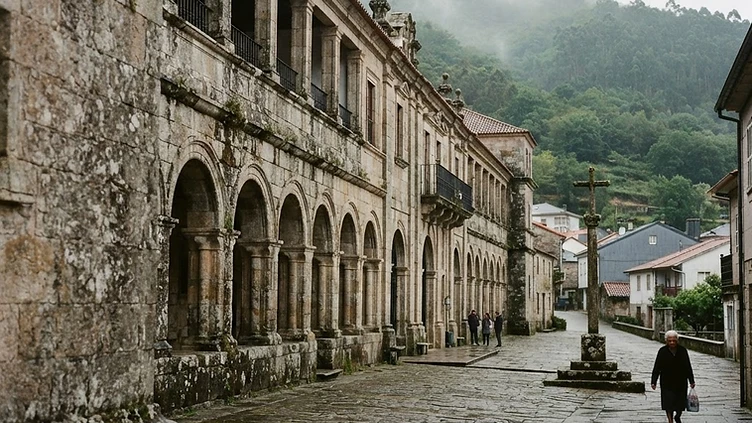
Stop on the walk between Triacastela and Sarria rather than making a detour of it: this is a working monastery, so you see the church and a cloister, not a monument circuit. Forty minutes, and it is the oldest thing for a long way in any direction.
A Benedictine monastery on the Camino Francés, occupied continuously since the 6th century — the largest in Galicia, with two cloisters and a pilgrim hospital that has never really closed.
At a Glance
The monastery sits at the bottom of the Oribio river gorge, where the valley stays green and damp for most of the year. Two cloisters, their weathered flags underfoot, set Renaissance arches against the rigid geometry of a later Neoclassical wing. The air holds wet moss and slate, a sharp change from the dust of the Camino above. Distant chanting carries down the valley and stops at the granite walls.
How it got here
Monastic life at Samos persists from the sixth century within the valley of the Oribio river. The site claims a foundation linked to the Suebi kingdom, though successive fires and reconstructions altered the original structure. Benedictine monks maintain the site, linking the modern Camino Francés to the early medieval ascetic traditions of Galicia. The architecture bridges centuries, placing the austere stone of the sixteenth century Renaissance cloister against the rigid, repetitive proportions of the Neoclassical cloister finished in the eighteenth century. These granite walls endure as a primary waypoint for pilgrims crossing the Galician interior toward Santiago de Compostela.
Where it sits
Deep green slopes of the Oribio river gorge trap humidity, keeping the valley floor damp while the surrounding Galician highlands remain exposed to shifting Atlantic weather. Thick mists settle in the basin during autumn and winter, while summer heat struggles to penetrate the heavy shade of local chestnut and oak forests. Access follows the old mountain tracks used by pilgrims for generations, descending sharply from the plateau into the monastery grounds. Heavy rainfall sustains the river, keeping the landscape lush throughout the year, far removed from the dry, open plains of the meseta to the east.
What to eat and drink
Pulpo á feira, octopus boiled in copper cauldrons and dressed with olive oil, paprika, and salt, defines the local diet. The province leans heavily on lacón con grelos, a rustic plate of cured pork shoulder served with the bitter greens of the turnip plant. Empanada gallega, a dense pastry stuffed with cod or pork, provides sustenance for the long road. To drink, the sharp, acidic white wines from the nearby Ribeira Sacra provide a necessary contrast to the heavy, lard-based cooking that persists in these high, cool valleys.
Galicia: the whole region
Galicia is wet, green, cheap and unlike anywhere else in Spain: a drowned coast of rias, granite villages, seafood that justifies the trip on its own, and Santiago at the middle of it. The rain is not a risk, it is a certainty — plan…
Minimum 5 days · better 8-10 days · deep 2 weeks
What's Nearby

In Galicia




In Galicia


In Galicia





Logistics are verified only. We don't publish schedules we haven't confirmed.
Appears In
Ready to build Monasterio de San Xulián de Samos into a trip?
You've found a place worth going. When you're ready to turn discovery into an itinerary, Travel Itinerary Co picks up where the Field Guide leaves off — with your saved places already in hand.
Build this into a tripContinues on Travel Itinerary Co
Spain Field Guide may earn a commission when you book through selected links. Recommendations are editorial and independent of commission.